
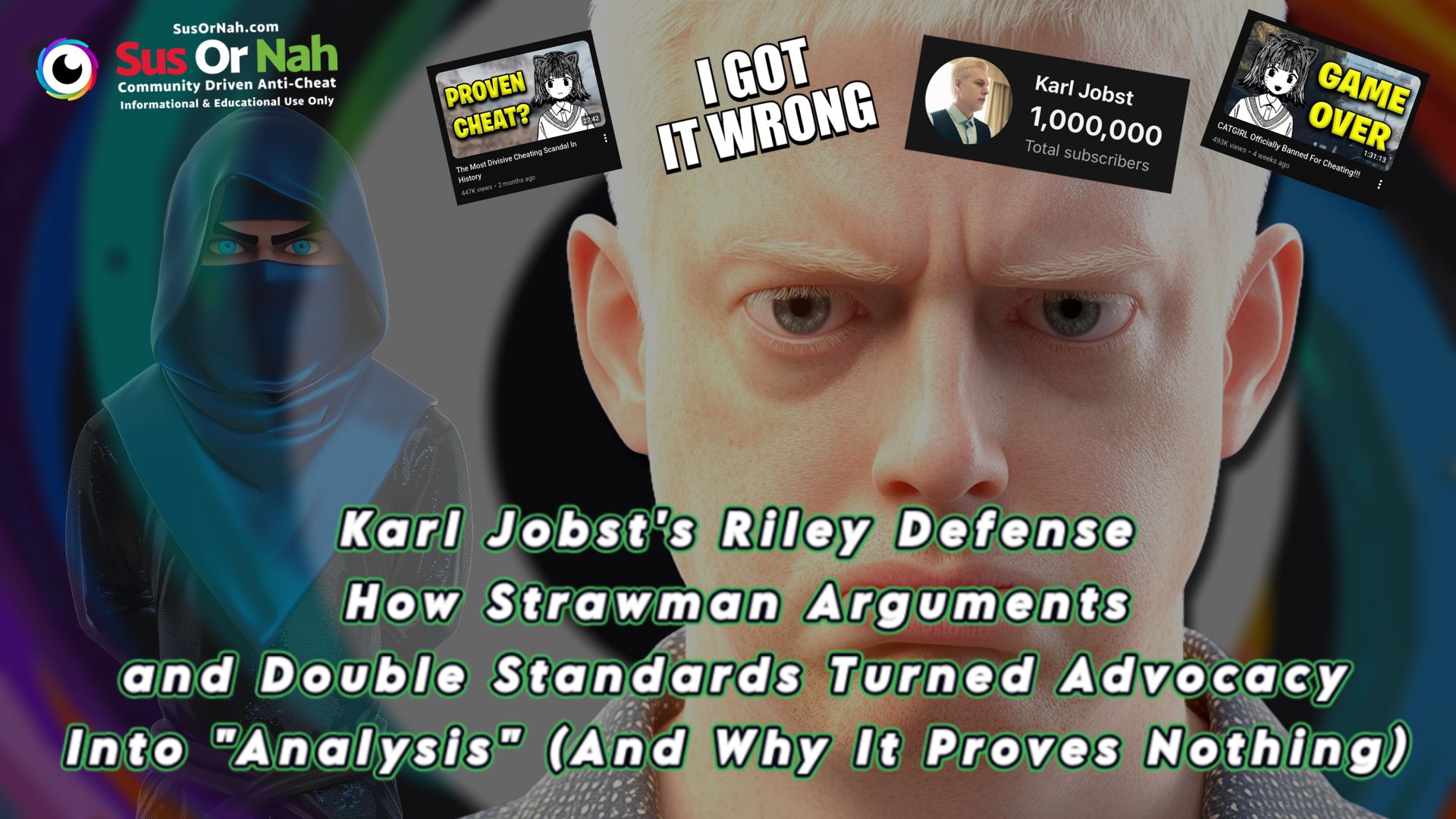
In a stunning display of intellectual gymnastics, Karl Jobst—the YouTuber who built his “reputation” on “exposing cheaters”—Released a 90-minute and 30 minute defense piece so one-sided it would make a political campaign ad blush.
For years, Karl Jobst has positioned himself as gaming's “ultimate truth-seeker”. His catchphrase “Hello you absolute legends” precedes deep-dive investigations into cheating scandals across speedrunning and competitive gaming. He's taken down fraudsters, defended the falsely accused, and earned a “reputation” for “fairness”.
That “reputation” just took a critical hit.
On September 24th, 2025, Jobst released “CATGIRL Officially Banned For Cheating!!!”—a sprawling 90-minute video “ostensibly debunking” claims that Battlefield 6 player RileyCS was cheating. But here's the problem: Jobst didn't actually debunk anything. He just moved goalposts, strawmanned arguments, and ignored the strongest evidence while nitpicking the weakest claims.
Even more damning? His earlier video from two months prior shows he was already committed to defending Riley before doing the investigation he claims to have done.
Let's break down how badly Karl Jobst fumbled this one.
In August 2025, Riley “Catgirl” CS posted a Battlefield 6 montage that immediately exploded across social media. The clips showed aim so precise, so mechanical, that it triggered one of gaming's biggest cheating debates in years. Riley snapped between targets with inhuman precision, appeared to track enemies through walls, and displayed movement patterns that veteran FPS analysts flagged as suspicious.
Major streamers like Asmongold and Tectone reacted. The clips earned nearly 100 million views. Professional anti-cheat analysts weighed in. Riley's “team”, Team EXE, had already kicked another member (Shimmy) for using aimbots just months prior.
Karl released his first video on October 24th, 2025: “The Most Divisive Cheating Scandal In History.” Right out of the gate, he framed this as him correcting “misinformation” while maintaining he wasn't defending Riley:
“I would never say he isn't cheating, that's always possible, but given how many misconceptions there are floating around, I don't trust much at this point in time.”
But watch what he actually does. Every single argument in that 27-minute video favors Riley's innocence. Every piece of suspicious evidence gets an alternative explanation. Every critic gets strawmanned.
Karl's rhetorical shield throughout both videos is that he's merely a neutral fact-checker. He repeats variations of this constantly:
From the first video:
“These are the big lies that make him completely unreliable. But as we will soon see, he basically lies about everything.”
From the second video:
“I am less a defender of Riley as I am a defender of logic and not jumping to conclusions. I have never once said that Riley didn't cheat.”
This is textbook motte-and-bailey fallacy. The “motte” (defensible position): “I'm just correcting factual errors.” The “bailey” (actual position): “All evidence against Riley has been debunked and he's probably innocent.”
Karl spends 90 minutes in his second video systematically dismantling every argument against Riley while offering zero serious engagement with the strongest evidence. He attacks Call of Shame's credibility, nitpicks terminology, and focuses on debunking the weakest claims while ignoring the elephants in the room.
When you “correct misinformation” exclusively in one direction, you're not fact-checking. You're advocating.
Karl's foundational defense of Riley rests on a comparison to speedrunning:
“As someone who has been in the speedrunning community for over 25 years, I can tell you from experience there was a time that whenever a casual viewer watched a speedrun, they would say it's fake.”
He shows “examples” of seemingly impossible speedrun tricks that turned out to be legitimate, arguing that Riley's aim could be the same situation—people just don't understand how good aim trainers can be.
This is a false equivalence, and Karl knows it.
Speedruns involve deterministic, reproducible mechanics. When a speedrunner pulls off a frame-perfect trick, they can do it again. The game's code doesn't change. The physics are consistent. That's why speedruns can be verified—you can test whether a trick is humanly possible by attempting it under controlled conditions.
FPS aiming is probabilistic and involves human neuromuscular limits. While skilled aimers can be incredibly precise, they have statistical patterns. Reaction times have distributions. Micro-corrections follow biomechanical constraints.
When multiple clips show patterns that fall outside human performance parameters—not just “really good” but mechanically anomalous—that's different from a speedrun trick people haven't seen before.
Karl uses this analogy to shut down skepticism, but it's fundamentally dishonest. He's comparing apples to oranges to make his case.
The most infamous clip shows Riley flicking 90 degrees to his left and appearing to track an enemy behind a large rock. Karl spends significant time on this:
“Riley turned to the direction of someone on the minimap, and there were a total of four enemies behind that rock… So with four enemies behind that rock, it isn't shocking that his crosshair ended up in general vicinity of one of them.”
Let's break down what Karl is actually arguing here:
Here's the problem: Karl is applying an impossibly high burden of proof. He's essentially saying “unless we can see through the wall in real-time, we can't say anything suspicious happened.”
But that's not how analysis works. The question isn't “can you prove with 100% certainty he was locked on?” The question is “does the movement pattern suggest mechanical assistance?”
Karl admits:
“The best excuse I had heard was that sometimes people get lucky.”
Wait—so Karl's defense is luck? The minimap? That he was “already shooting so he kept shooting”? These are the arguments of someone reaching for explanations, not someone conducting neutral analysis.
Watch his language throughout:
“Personally, I don't find this to be that crazy.”
That's not analysis. That's opinion stated as counterargument. Karl has decided Riley is probably innocent and is working backward to explain away evidence.
Karl's second major argument is that aim trainers are better than pro players, therefore Riley's clips aren't that suspicious:
“In 2023, Red Bull hosted an event called Ready Check, which was a competition based solely around aim… In every single round, the lowest scoring non-professional scored higher than the highest scoring professional.”
He concludes:
“Riley is someone who specializes in aiming. he has over 1500 hours in the Kovacs Aim Trainer alone. he is on a team that specializes in aiming. If his aim is better than esports pros, that doesn't mean he could be a pro himself.”
This argument has a catastrophic logical flaw.
Yes, aim trainers can have better pure aim than pros. Nobody disputes this. The question isn't whether Riley's aim is too good to be human. The question is whether the patterns he displays are consistent with human aim or suggest mechanical assistance.
Karl conflates two completely different claims:
He debunks Claim A (which few serious analysts were making) and acts like he's addressed Claim B (which he completely ignores).
The Red Bull competition happened in controlled conditions with verified legitimate players on LAN setups. Using this to defend clips showing suspicious patterns in unverified online gameplay is intellectually dishonest.
Karl dedicates enormous portions of his second video to attacking Call of Shame's credibility. And to be fair, Call of Shame deserves criticism—the channel appears to use AI voices, has made factual errors, and has presented questionable credentials, however Call of Shame hasn't always been wrong about everything nor right.
But here's where Karl reveals his hand.
He spends over 40 minutes attacking Call of Shame's:
This is all potentially valid criticism. But it's completely irrelevant to whether Riley is cheating.
Karl commits a textbook ad hominem fallacy—attacking the person making the argument rather than the argument itself. Even if Call of Shame is a complete fraud, that doesn't make Riley innocent.
More importantly, Call of Shame isn't the only person raising concerns. Professional analysts, former pro players, anti-cheat specialists, and other content creators have all flagged Riley's gameplay. By focusing obsessively on the weakest and most dishonest accuser, Karl creates the impression he's debunked the whole case.
He hasn't. He's just attacked one messenger.
Karl's treatment of Riley's Twitch bans perfectly illustrates his double standard.
Riley was banned twice on Twitch—once in October 2024 and once recently. Karl addresses both:
For the 2024 ban:
“After Riley was banned in October of 2024, he appealed. And his appeal was accepted. His original ban was on October 18th. After appealing, Riley received an email on October 22nd saying that the ban was due to a mistake on our part.”
For the recent ban:
“When I asked Enders what his evidence for this was, he said he didn't have any and it was just an assumption. It should go without saying that you shouldn't make claims like this so confidently without proper proof.”
Notice the standard shift?
For evidence supporting Riley: Accepts email at face value, doesn't question authenticity, treats it as definitive.
For evidence against Riley: Demands proof, calls assumptions inappropriate, applies maximum skepticism.
Karl even admits:
“I'm not going to put any stock on a random Twitch employee who clearly hasn't done a thorough investigation.”
So Twitch employees who unban Riley are making correct decisions, but Twitch employees who maintain bans are unreliable? The inconsistency is staggering.
When addressing why Riley's performance dramatically improved between Day 1 and Day 2 of the beta, Karl offers this explanation:
“However, this just seems to be a huge display of ignorance. It's a well-established proven fact that the frame rate drastically affects aim.”
He cites Linus Tech Tips experiments showing aim improves with higher framerates, and NVIDIA data showing correlation between FPS and K/D ratio.
This is a partial truth being used as a complete explanation.
Yes, FPS affects performance. Nobody disputes this. But Karl is using it to explain away a dramatic skill differential that multiple analysts found suspicious.
He argues:
“So his aiming ability was going to improve dramatically no matter what, given this increase. And when you couple that with the simple fact that people improve on their second day of performing any task, this increase in skill is not surprising at all and is even to be expected.”
“Not surprising at all”? A player going from struggling to dominating overnight isn't surprising because of FPS and practice?
This is Karl doing what he accuses others of—making definitive statements without adequate support. FPS changes and one day of practice could account for some improvement. Whether they account for the magnitude of improvement Riley showed is the actual question.
Karl doesn't engage with that question. He just asserts the answer.
One of the more suspicious clips shows Riley flicking to enemies obscured by smoke. Critics argued he couldn't have seen them. Karl's response:
“When I view the original, the enemy is clearly visible. And when you see the enemy, you realize the flick wasn't even accurate, and it took multiple shots before Riley adjusted.”
He shows high-quality footage where the enemy is somewhat visible and concludes:
“So when viewing the actual footage, you see that not only can you see the enemy clearly, but the snap was completely off target.”
This is misleading on multiple levels.
First, Karl is viewing paused, high-quality footage with full knowledge of where the enemy is. That's completely different from real-time gameplay visibility. Just because you can see something when you're looking for it in a paused video doesn't mean it was visible during live play.
Second, “the snap was completely off target” contradicts his own footage. The initial flick was in the correct direction and close to target, requiring only minor adjustment.
Third, Karl completely ignores that Riley did this multiple times. Cherry-picking one clip where there's marginally better visibility doesn't explain the pattern.
When addressing why the rock clip is the only example of apparent wall-tracking, Karl argues:
“We also never see this type of instant snapping to enemies through walls in any other clips, and no one has been able to produce another example of this happening, despite Riley streaming many hours every day.”
This is survivorship bias in action.
If Riley is cheating, he would obviously avoid repeatedly displaying the same obvious tell. The fact that one egregious example exists doesn't mean we should expect dozens more.
Moreover, Karl ignores that the montage itself is a curated highlight reel. Riley chose which clips to include. If he's cheating, he wouldn't include multiple clips showing the same obvious pattern.
Karl even acknowledges this about legitimate players:
“In order to farm these clips, Riley has to intentionally ignore enemies, run out into the open, and pray he doesn't get spotted and killed while he attempts to chain a bunch of kills together by target switching.”
So Riley is selective about which clips make the montage when it comes to showing good plays, but we should expect his to include multiple examples of the same suspicious pattern if he's cheating?
The logic doesn't track.
Throughout both videos, Karl has an inconsistent relationship with expert opinion.
When experts support Riley:
“Matty, the aimer who won Red Bull's Ready Check competition… believes that these clips aren't anything out of the ordinary. When the best aimer in the world, and possibly of all time, believes that Riley isn't cheating, this should give you pause.”
When experts doubt Riley:
“Call of Shame has also said this particular clip is both not cheating, and also obviously cheated… Pointing out contradictions isn't proof that Riley isn't cheating.”
Karl dismisses Twitch's judgment:
“I'm not going to put any stock on a random Twitch employee who clearly hasn't done a thorough investigation.”
But he accepts without question Riley's claimed 1500 hours in Kovacs and his team affiliation as legitimate credentials.
The pattern is clear: Expert opinion matters when it supports Riley, and should be dismissed when it doesn't.
One of Karl's more manipulative arguments is his appeal to due process and fairness:
“I believe it is immoral to not allow the accused person to defend themselves. And that's also why it's in the Constitution… But Tectone seems to disagree.”
He attacks critics for being upset that he interviewed Riley:
“Listen to this. ‘When Karl Jobst put out a video attempting to defend Riley CS, I was honestly confused because he has some actually pretty amazing videos, and then I quickly realized why he did it. If you're going to make an impartial video, you should never let a blatant cheater dictate how you tell your story.' I believe it is immoral to not allow the accused person to defend themselves.”
This is a false dilemma and a misrepresentation.
Nobody is saying Riley shouldn't be allowed to respond to accusations. The criticism is that Karl's investigation appears compromised because he only presented Riley's side. He interviewed Riley, showed his perspective, and systematically dismissed or explained away every piece of contrary evidence.
“Due process” doesn't mean presenting only the defense's case. It means weighing both sides fairly.
Karl's videos do the opposite. He presents Riley's explanations uncritically while subjecting every accusation to maximum scrutiny.
Here's what's remarkable about Karl's 90-minute “debunk” video: He never seriously engages with the strongest evidence.
He doesn't address:
Instead, he focuses on:
This is the classic defense attorney tactic: create reasonable doubt about specific pieces of evidence while avoiding the bigger picture.
At the end of his second video, Karl says:
“Personally, I don't know if Riley cheated, either now or in the past. As I said in my previous video, the only thing I know for certain is that the most outspoken Riley detractors are the ones who are spreading the most misinformation.”
But here's what he won't address: If you're truly neutral, why does every single argument you make favor one conclusion?
Karl can claim neutrality all he wants. His actions tell a different story.
Karl dedicates substantial time to criticizing how Asmongold and Tectone responded to Call of Shame's videos:
“Tectone and Asmongold are basically like baby birds with their mouths open, just eagerly gulping down whatever half-digested garbage Call of Shame decided to regurgitate up for them. They both question nothing and believe everything is fact without any hesitation.”
He's particularly upset about being characterized as defending Riley:
“All I do is disagree about whether or not you could tell if Riley was tracking someone through a rock, and in response, Tectone lies to his audience. He tells them that I said he and Asmongold were bad, and that I went in on him hard.”
Karl is missing the point entirely.
The criticism isn't that Karl disagreed about the rock. The criticism is that Karl produced a systematically one-sided analysis while claiming to be neutral. Tectone and Asmongold may have been imprecise in their language, but their core criticism—that Karl is functioning as Riley's defense attorney—is accurate.
After 90 minutes of “investigation,” Karl concludes:
“Every single point they have raised can be adequately explained, or is just a complete lie so an explanation isn't even required. And until actual concrete proof of cheating or a confession is provided, I will continue to remain skeptical.”
This reveals everything.
Karl has decided that unless there's a confession or absolute proof, he'll remain “skeptical” of cheating accusations. But he applies no such skepticism to Riley's defenses.
He demands “concrete proof” while treating circumstantial explanations as adequate debunking.
This isn't investigation. This isn't neutral analysis. This is advocacy disguised as fact-checking.
Some might ask: why does this matter? It's just one YouTuber's opinion about one cheating accusation in one game.
It matters because Karl Jobst built his reputation on being better than this.
For years, Karl has been the standard-bearer for thorough investigation in gaming. When he covered Billy Mitchell, Todd Rogers, and Dream, he was meticulous. He acknowledged counter-arguments. He admitted uncertainty when appropriate.
This Riley investigation is different. It's sloppier. It's more one-sided. It's less honest about its own biases.
And when someone with Karl's platform and reputation produces work this compromised, it damages trust in the entire process of investigating cheating in gaming.
Karl needs to answer some questions:
Karl Jobst's Riley CS “investigation” isn't an investigation at all. It's advocacy.
He cherry-picked weak arguments to debunk while ignoring strong evidence. He applied asymmetric standards of proof. He attacked messengers rather than engaging with messages. He hid behind claims of neutrality while producing systematically one-sided analysis.
Most damningly, he did all of this while claiming the moral high ground—accusing others of being biased, dishonest, and rushing to judgment.
The speedrunning detective forgot his own methodology. Or worse: he remembered it but chose not to use it.
Karl Jobst has spent years “building credibility” as gaming's most “thorough investigator”. In 90 minutes, he spent a lot of that credibility defending someone he can't prove is innocent by attacking people he can't prove are wrong.
The absolute legend delivered an absolute L.
And the worst part? He probably still doesn't see it.
The real question is whether Karl Jobst's investigative standards apply equally to everyone, or only when it's convenient.
Based on these videos, we have our answer.