
When Influence Becomes Immunity: A Pro Player Reveals the Broken System
On October 30th, 2025, professional Call of Duty player Destroy made a startling admission during a live stream that confirms what the community has suspected for years: the ban appeal system is fundamentally broken, and access to justice depends entirely on who you know at Activision.
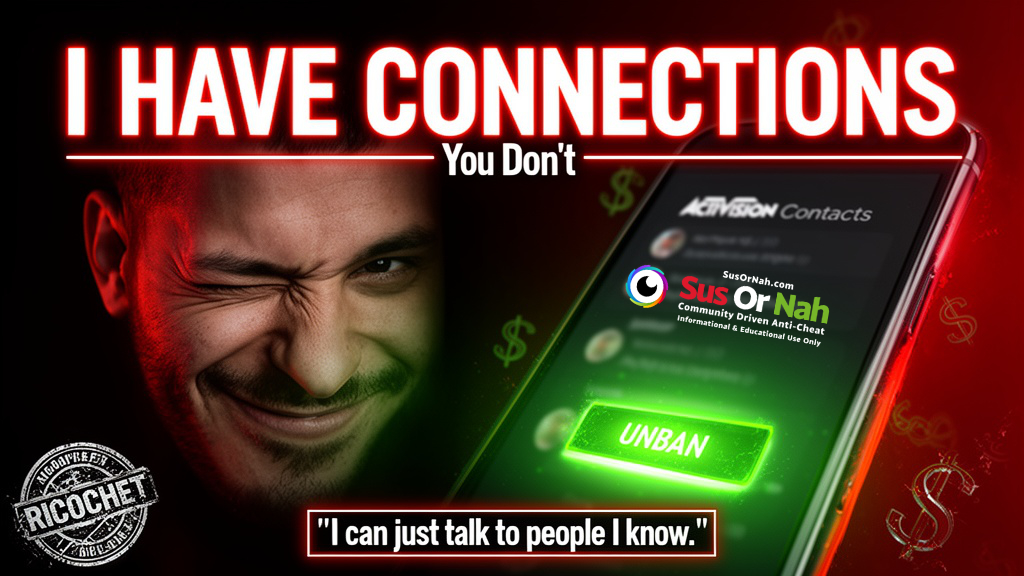
While discussing his own permanent ban and subsequent reversal, Destroy casually revealed the two-tier system that governs competitive Call of Duty: “I got unbanned obviously like I can go talk to people that I know and go get myself unbanned, you know, like but not everybody can do that… which is a bit obnoxious, you know, if you don’t have connections.”
This wasn’t a slip of the tongue. This was a professional player openly acknowledging that Activision operates a system where your ability to appeal a ban depends not on the evidence, but on your contact list.
Let’s break down exactly what Destroy said, because the implications are damning:
“I got unbanned obviously like I can go talk to people that I know and go get myself unbanned”
This confirms:
“But not everybody can do that… which is a bit obnoxious”
This acknowledges:
“If you don’t have connections… it’s tough”
This admits:
Destroy, a professional player who placed 10th at the WSOW (Call of Duty World Series of Warzone), was hit with a permanent ban by Ricochet anti-cheat. Like Metaphor, like Bobby Poff, like numerous other high-profile players, his ban was reversed.
His defense follows the familiar pattern:
But what makes Destroy’s case particularly revealing is his honesty about how he got unbanned. While other streamers pretend their reversals came from thorough technical review proving their innocence, Destroy admitted the truth: he made phone calls to people he knows.
Destroy specifically mentions Bobby Poff as another example of someone who was banned and unbanned. This is presented as evidence that false positives happen and the system is flawed.
But consider the alternative interpretation: What if all these bans were legitimate, and Activision simply reverses them for connected players?
The pattern is undeniable:
Every time this happens, it reinforces the same message: The rules don’t apply if you’re important enough.
Destroy also revealed another layer of favoritism in Activision’s treatment of influencers: the “streamer mode waitlist.”
According to Destroy:
Streamer mode protects players from being targeted by stream snipers and prevents their username from appearing in killcams. It’s a significant competitive advantage that Activision grants to select players based on… what criteria exactly?
If the waitlist were merit-based, professional players competing at the highest level would be prioritized. If it were popularity-based, it would be transparently corrupt. The fact that it took Destroy years to get access despite being a top competitive player suggests the system is neither fair nor logical—it’s purely discretionary favoritism.
This line is particularly telling. Destroy, someone with extensive connections in the competitive COD scene, has no idea who else is supposedly on this waitlist or what the criteria are for approval.
This suggests:
The streamer mode issue mirrors the ban appeal problem: both systems operate on hidden criteria where access depends on favoritism rather than fairness.
Destroy’s admission reveals two completely different experiences of playing Call of Duty:
If you’re a connected player:
If you’re a regular player:
One viewer in Destroy’s chat captured this perfectly: “If you don’t have connections, it’s tough.”
Actually, it’s not “tough”—it’s impossible. Regular players don’t have a different path to the same outcome; they have no path at all.
Destroy claims “Ricochet is just pretty disappointing” and needs a “complete overall revamp.” But what exactly is disappointing about it?
From his perspective as someone who was banned and unbanned:
So from Destroy’s position, Ricochet is “disappointing” because… it tried to enforce the rules on him? And then he circumvented those rules through connections?
This framing is backwards. Ricochet isn’t disappointing for banning players who trigger detection—it’s disappointing for allowing those bans to be overridden by influencer relations.
Here’s what Destroy’s admission reveals: The system is working exactly as designed.
Activision doesn’t want an anti-cheat that uniformly enforces rules. They want an anti-cheat that:
This creates the best of both worlds for Activision:
Destroy’s casual admission that he can “go talk to people and get unbanned” isn’t a bug in the system—it’s the entire point.
To Destroy’s credit, he at least acknowledges the unfairness: “Not everybody can do that… which is a bit obnoxious.”
But this acknowledgment rings hollow when he:
Saying “it’s a bit obnoxious” while actively exploiting the broken system is like a politician condemning corruption while taking bribes. The admission without action is just reputation management.
If Destroy truly believed the system was unjust, he could:
Instead, he benefits from the inequality while occasionally commenting that it’s “obnoxious” for those without his advantages. This is complicity dressed as criticism.
Both Destroy and his chat participant agree: “The system needs an overall revamp.”
But what would a genuine revamp look like? Because right now, when influencers call for “revamp,” what they actually mean is:
A real revamp would mean:
Destroy isn’t calling for this kind of revamp. He’s calling for a system that’s less inconvenient for him personally while maintaining his structural advantages.
Destroy states definitively: “I’ve never cheated in my life.”
This claim deserves scrutiny, not because we have evidence he’s lying, but because every caught cheater makes the exact same claim.
Consider the logical problem:
But there isn’t massive outcry from regular players claiming false bans. The outcry comes almost exclusively from streamers and pros who:
Meanwhile, Reddit and forums are filled with regular players saying: “I got banned and I actually was cheating, the system works” or “I got banned and deserved it.”
The false positive narrative is almost exclusively pushed by the same people who have the most to gain from it.
Destroy placed 10th at the Call of Duty World Series of Warzone—a major competitive event. He’s allegedly a “legitimately skilled player” competing at the highest level.
But here’s the problem his admission creates: How can anyone trust competitive results when we know enforcement is selectively applied?
If Destroy or any other pro:
Then the competitive scene isn’t measuring pure skill—it’s measuring who can cheat subtly enough to avoid permanent consequences.
This isn’t an accusation that Destroy cheats. It’s an observation that the system he defends makes verification impossible. When connected players can bypass enforcement, competitive integrity becomes unknowable.
Throughout this clip, there’s an undertone of “poor me, the system is so flawed” from someone who literally admitted he can bypass the system whenever he wants.
Destroy positions himself as a victim of Ricochet’s incompetence, when in reality he’s a beneficiary of Activision’s favoritism. The framing is:
What Destroy says: “Ricochet is disappointing, it banned me even though I’m innocent”
What’s actually true: “Ricochet detected something, I used connections to override the ban, regular players can’t do this and it’s unfair”
This gaslighting extends to the broader streamer community, where:
But Destroy’s own words reveal the truth: The system isn’t broken because it bans innocent people. It’s broken because it allows guilty people with connections to escape consequences.
1. What specifically triggered your ban?
If it was truly a false positive, what software or configuration caused it? Share details so others can avoid it.
2. Who did you contact at Activision to get unbanned?
Name the people who reversed your ban. Let the community know who’s making these decisions.
3. What evidence did you provide to prove your innocence?
Was there a technical review? What did it find? Why aren’t these findings public?
4. Why do you continue using the same setup that got you banned?
If something on your system triggered a false positive, why haven’t you changed it?
5. Do you believe regular players deserve the same appeal access you have?
If yes, what are you doing to advocate for them? If no, why not?
Destroy has answered none of these questions. Like Metaphor, like Bobby Poff, like every other unbanned streamer, he provides no transparency, no accountability, and no solutions.
Everything Destroy describes—the connection-based appeals, the arbitrary streamer mode waitlist, the lack of transparency—requires Activision’s active participation.
This isn’t a rogue employee helping out friends. This is a systematic policy where:
When Destroy says “I can go talk to people I know and go get myself unbanned,” he’s describing institutional corruption that Activision has chosen not to fix.
The company benefits from this arrangement:
Destroy’s admission should trigger an internal investigation at Activision. Which employees are reversing bans? What criteria are they using? Why is this authority concentrated in influencer relations rather than anti-cheat engineering?
These questions won’t be answered, because asking them would expose the corruption that Destroy casually admitted exists.
One person in Destroy’s chat said: “I don’t have connections… it’s tough.”
This viewer understands the reality: If you’re not famous, you’re not protected.
Imagine being this person:
How do you not feel completely demoralized and betrayed?
This is the community cost of the system Destroy describes. Every regular player knows they’re second-class citizens in a game where the rules only apply to those without leverage.
Destroy tries to frame this as “we all want better anti-cheat” as if his interests align with regular players.
They don’t.
What Destroy wants:
What regular players want:
These are fundamentally opposed interests. Destroy benefits from a system that regular players suffer under. His call for “revamp” is not solidarity—it’s self-preservation.
Destroy’s casual revelation—“I can go talk to people I know and go get myself unbanned”—is the most honest statement we’ve heard from a professional player about how Call of Duty’s enforcement actually works.
It confirms:
This isn’t speculation or conspiracy theory. This is a professional player, on stream, explaining exactly how the system works and admitting it’s unfair.
The question is: what happens now?
Will Activision address this admission and reform their appeals process? Will they create equal access for all players? Will they investigate who’s reversing bans and on what basis?
Or will they ignore it, knowing that Destroy’s audience will defend him, the broader community will forget, and the next ban cycle will repeat the exact same pattern?
Based on history, we know the answer.
Until there are real consequences for this favoritism—legal challenges, sponsor pressure, mass player boycotts, regulatory scrutiny—nothing will change. Activision has no incentive to fix a system that serves their business interests perfectly.
Destroy will keep getting unbanned. Regular players will keep getting ignored. And competitive Call of Duty will continue to be a rigged game where the rules only apply to those who can’t call in favors.
The corruption isn’t hidden anymore. Destroy said the quiet part out loud. The only question is whether anyone will actually do something about it.
“I can go talk to people I know and go get myself unbanned… but not everybody can do that… which is a bit obnoxious.”
— Destroy, admitting to systematic corruption while calling it “a bit obnoxious”